my crohn’s story
Not just credentials … real life.
"I woke up one morning and couldn't lift my right leg."
The day before, I had been training. Working. Living the life I had built - active, physical, full of energy and purpose. Surfing when I could. Martial arts. The kind of life where your body is your own and you never once think to question it. And then, without warning, it wasn't anymore.
The pain came in waves. Gripping, breathtaking, arriving without warning and leaving me unable to move, unable to stand up straight, unable to think about anything else. I didn't know what was happening. I didn't know if it was serious. I just knew that something had changed - and that nothing about how I felt that morning matched anything I had felt before.
After an urgent trip to the doctor and a very painful physical examination, I was sent straight to hospital. I remember thinking it was a shame I had to cancel work that evening.
What followed was weeks in a hospital bed. Weeks of not knowing. Scans. Tests. Days that blurred into one another. Each appointment bringing more questions than answers. Each result ruling something out but not yet telling me what was in. That unknown is one of the most frightening places a human being can be - your body is clearly telling you something is very wrong, but nobody can yet tell you what. Your mind fills the silence with its worst imaginings.
Now I'm going to be really honest
I remember it very clearly. Being in Beaches ward - a small room tucked away deep in the hospital. Just enough space for six beds. No windows. No natural light. No fresh air. That room is one I will never forget. One I never wish to go back to. One I wouldn't wish on anyone.
The air was heavy. It held the odour of the five seriously ill men who were already in the room when I arrived. Two of them passed away during my time there. I was given the bed in the middle row - surrounded, hemmed in, trapped in something that felt like a nightmare I couldn't wake from.
One particular night, feeling claustrophobic and completely lost, I got out of bed and walked. Down the empty, darkened hallway. Further and further, working my way towards the exit of the hospital. When I finally reached the entrance, my heart sank. Heavy green metal shutters, pulled down over the doors.
I collapsed into one of the waiting room chairs. Completely alone. In the semi-darkness of a hospital entrance that had shut the world out. And I had my first panic attack. What felt like endless tears. I was certain, in that moment, that my life was done - and I could see no way back from that low point.
"I'm telling you this because what came next was the moment everything changed."
One morning I sat up. I looked around at the other men in that room. And it hit me. I was the only one in that room who was blessed enough to be able to stand up and walk. While these men - and so many others throughout that hospital - would have given everything for that simple privilege, I had been doing nothing but thinking about how bad I had it.
Something shifted in me that morning. Deeply and permanently. I started small - bringing puzzle books back from the hospital shop, sitting with some of the older men who hadn't spoken to anyone in days. It was in those small acts that I found something I thought I had lost entirely: purpose.
And it was in that room, in that moment, that I made a quiet promise to myself. That when I got out of hospital, one day I would create something so that nobody would have to feel that alone in facing something this life-changing. Not if I could help it.
Then the diagnosis came. Fistula Crohn's disease. The consultant explained it - inflammation of the digestive tract, fistulas forming where they shouldn't, a chronic condition with no cure - and I sat there trying to hold words that kept slipping through. Confused. Scared. No idea what had just hit me or how hard.
"I will never forget the moment the doctor sat down on the end of my hospital bed and told me I would likely never do the hobbies I loved again. 'You'd be better off learning a musical instrument.' Those words terrified me then. They motivate me now."
Treatment began almost immediately. Prednisolone first - steroids to bring the inflammation under control. The side effects were significant. My face changed. My body changed. My mood swung in ways I wasn't prepared for. There is something deeply disorienting about looking in the mirror and not recognising the person looking back - not just because of the illness, but because of the treatment for it.
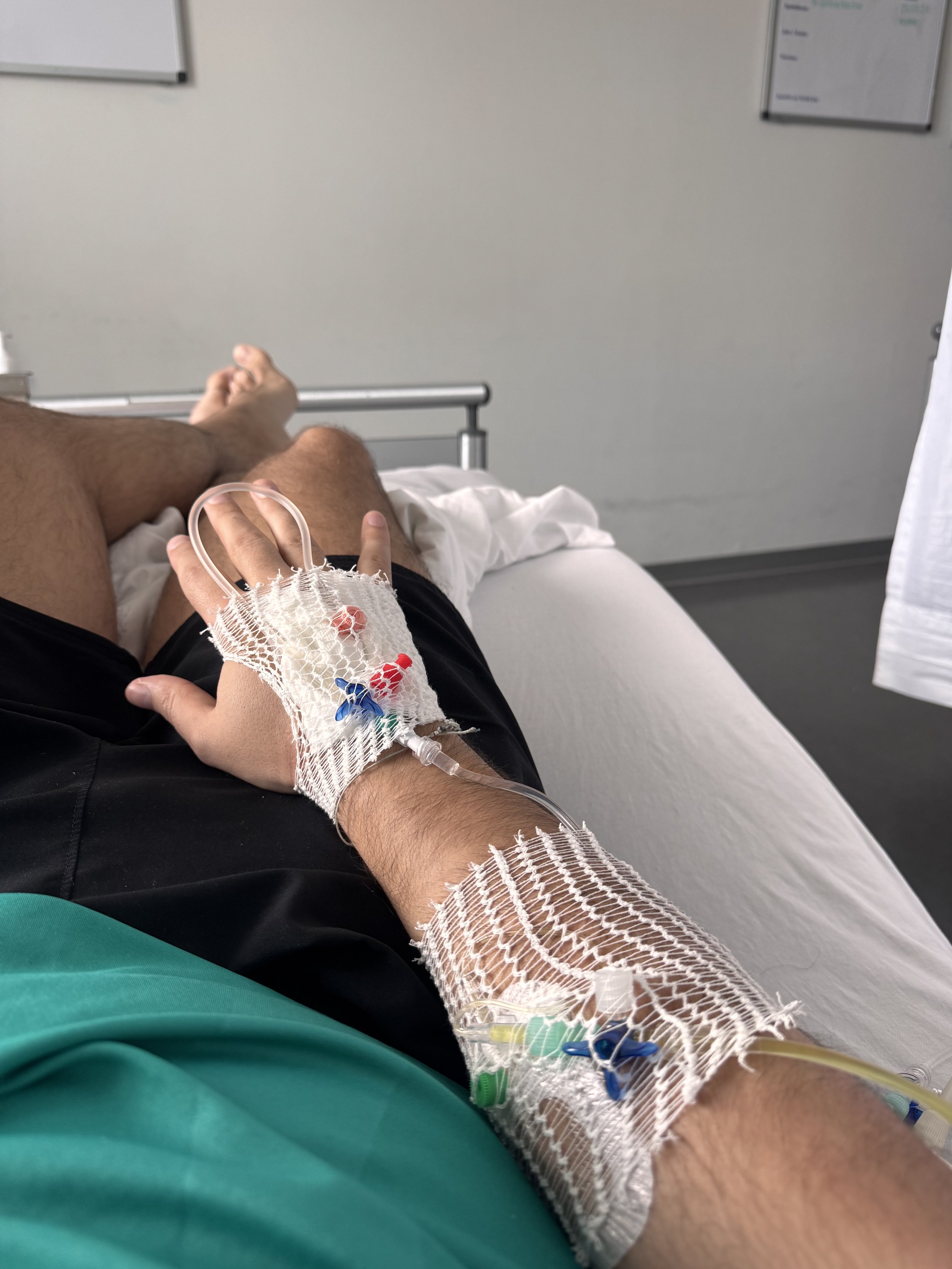
Then Infliximab. A biologic infusion, administered every few weeks in a hospital setting. You sit in a chair. A cannula goes into your arm. And for the next few hours, medication drips slowly into your bloodstream while you wait and hope that this time it holds. I am, honestly, incredibly grateful for Infliximab. It allowed me to leave hospital. It gave me a glimpse of a future I had almost stopped believing in.
But none of the physical symptoms - not the pain, not the fatigue, not the nutritional deficiencies - were the hardest part. The hardest part was what it did to my mind. Not being able to do the things I loved. The training I had built my identity around, gone. The physical confidence I had carried through my adult life, gone. A profound, disorienting loss of control. In my own body. In my own space. In myself.
The anxiety came. The low days came. A quiet, creeping depression I hadn't experienced before and didn't yet have the vocabulary for. I had spent my career helping other people through exactly these feelings - and now I was living them.
The turning point didn't arrive in one dramatic moment. It came in small things. Getting back into the gym for the first time - slowly, carefully, on my own terms. Learning what foods supported my gut and which inflamed it. How stress showed up physically in my body before I had even registered feeling stressed. How rest was not weakness but medicine.
Crohn's is still part of my life. It always will be. There are still hard days. Still flares and adjustments and the constant, low-level management that becomes, over time, simply part of how you live.
As I sit here writing this, I'm actually in a hospital bed in Zurich after a particularly nasty flare-up. Some familiar things - the pain, the hospital food, the wanting to be home. But some very different things too. I'm calm. I know I'm going to be okay. I know I'll only grow from this.
I have learned that the mind and the body are not separate things - that what happens to one always, without exception, happens to the other. I have found, on the other side of the hardest years of my life, a version of myself that is quieter, more grateful, more present - and more determined than ever to be genuinely useful to the people who need it most.
"The medical machines are still beeping. But they beep next to a very different Caerey now."
If you are reading this from a place of fear or exhaustion or loss - I want you to know that I see you. I understand more than you might expect. And I am here.
It may hurt now
But keep going
It’ll be worth it